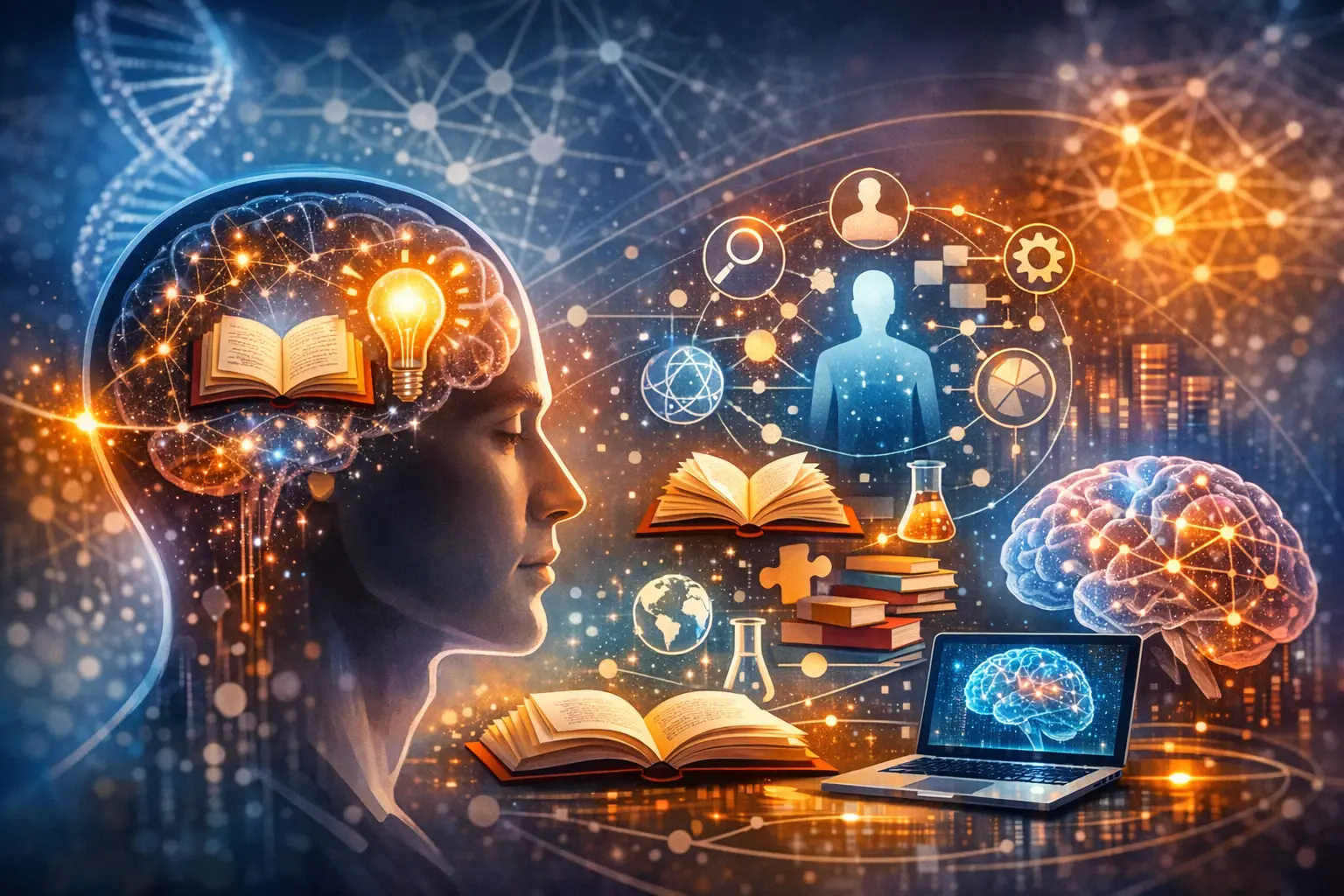
The Human Knowledge System Explained
Ever wondered how your brain actually learns and stores information? Understanding the human knowledge system is the first step to learning anything faster.
You read something. It makes sense. You feel like you’ve learned it. And then… it’s gone the next day. This isn’t a memory problem. It’s a misunderstanding of how learning actually works.
🚫 The Illusion of Learning
We assume exposure equals learning. Reading, watching, listening — it feels productive. But most of that information never becomes knowledge. Because information alone doesn’t stick.
🔄 Your Brain Doesn’t Store — It Transforms
Your brain isn’t a storage device. It’s a system that transforms information into meaning. Learning happens only when:
- New information
- Connects with what you already know
No connection → no retention.
⚡ Passive vs Active Learning
Passive learning:
- Rereading, highlighting
- Familiarity without depth
- Quickly forgotten
Active learning:
- Connecting ideas
- Asking questions
- Applying concepts
This is what creates lasting knowledge.
🧩 The 6-Stage Learning Process (Simplified)
Every lasting idea passes through this cycle:
- Input — You see or hear something new
- Questioning — Your brain asks: “What is this?”
- Understanding — You connect it to something familiar
- Patterns — Repetition builds structure
- Application — You use it → it sticks
- Refinement — Knowledge evolves over time
🔁 Learning Is a Loop
This isn’t a one-time process. Each cycle strengthens the next. That’s why learning gets easier the more you do it.
🎯 The Takeaway
You don’t need a better memory. You need a better approach.
Focus on:
- Understanding
- Connecting
- Recognizing patterns
- Applying
Because learning isn’t storing information.
It’s transforming it.